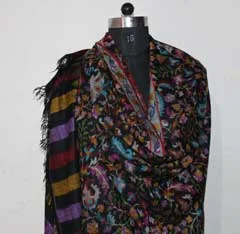
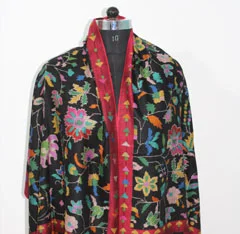
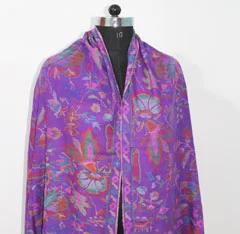
Exquisite handwoven Kani stoles crafted using centuries-old Tojli technique by National Award-winning Kashmiri artisans — available directly from our Delhi showroom or shipped nationwide.
A Pashmina Kani stole is a narrower, elegantly draped companion to the full Kani shawl — woven using the same revered technique, the same premium hand-spun cashmere fibre, and the same extraordinary level of artisan skill. The only difference lies in size; the artistry is identical.
Each stole is handwoven on a traditional loom by master weavers in Kashmir, often in pairs — two artisans seated side by side, building the design one stitch at a time. The vibrant, multi-layered patterns are brought to life by inserting fine Pashmina yarn wound around thin wooden bobbins called Kanis (or Tojli). For intricate Jamawar-style Kani stoles, dozens of these bobbins may be in use simultaneously, each carrying a different colour.
The weavers follow a precise coded pattern known as a Talim — a manuscript that instructs the exact placement of every coloured thread, row by row. This system has been passed down through generations and is the foundation of the Kani weaving tradition that originated in the Kashmir Valley.
Wrapped in a Kani Pashmina stole, you carry not just luxurious warmth, but a living piece of Kashmir's cultural heritage — wearable art that took skilled hands months, and sometimes longer, to create.
Explore Our Manufacturing ProcessThe word Kani refers to both the wooden bobbin used in weaving and the age-old technique itself. Each coloured thread in a Kani stole is individually inserted using these bobbins — a process that cannot be mechanised without losing the soul of the craft.
In a complex Jamawar Kani stole, over 100 individual Kanis may be used for a single design, each carrying a distinct shade of hand-spun Pashmina. The result is a reversible stole with mirror-perfect patterns on both sides — a feat impossible to replicate by machine.
Bhat Brothers is led by Shri Bhat, a recipient of the prestigious Shilp Guru National Award — India's highest honour for master craftspersons — recognising his outstanding contribution to the revival and preservation of Kani weaving.
Every Kani stole passes through a meticulous sequence of hand-crafted steps, each requiring generations of skill.
Pure hand-spun Pashmina wool is sourced from Changthangi goats in Ladakh and Nepal — the finest cashmere in the world.
A master craftsman encodes the complete pattern in a Talim, a row-by-row weaving script that guides every thread placement.
Each colour in the design is wound onto a separate wooden Kani bobbin. A complex Jamawar stole may require 100+ kanis simultaneously.
Two artisans work in unison on a traditional pit-loom, inserting each coloured thread stitch by stitch, following the Talim precisely.
Every completed stole is thoroughly inspected for weave tightness, colour accuracy, and pattern symmetry before leaving the workshop.
The stole is washed, dried, pressed, and carefully packed to preserve its delicate fibres for delivery to your doorstep.
Kani Pashmina stoles are priced as luxury heritage items because each one represents weeks, months, or even years of skilled human labour. No two pieces are identical. Here are the key factors that define the value of every Kani stole:
Understanding these factors helps you appreciate why an authentic Kani stole is an investment — not just an accessory — and why mass-produced imitations can never replicate its beauty or cultural significance.
Visit Our Delhi ShowroomA Kani stole is a narrower and shorter accessory compared to a full Kani shawl, but both are woven using exactly the same traditional technique — with wooden Kani bobbins, hand-spun Pashmina wool, and a Talim pattern guide. The artisan skill, quality of fibre, and weaving process are identical. The difference is purely in dimensions and how you choose to wear or drape them.
The price reflects the extraordinary amount of skilled human labour involved. Each stole is entirely handwoven stitch by stitch — a process that cannot be automated. Factors such as the number of colours (each requiring its own bobbin), the complexity of the Jamawar-style pattern, the tightness of the weave, and the number of months spent at the loom all contribute to the final price. These are heritage luxury items, not mass-produced accessories.
Weaving time depends entirely on the complexity of the design. A simpler Kani stole with a few colours and a bordered pattern may take two to four months. A fully detailed, multicolour Jamawar-style Kani stole can take six months to over a year, as two artisans work together, inserting one stitch at a time in a highly controlled sequence guided by the Talim pattern manuscript.
Authentic Kani stoles are made from 100% pure Pashmina (cashmere) wool, hand-spun from the fine undercoat of Changthangi goats native to the high-altitude regions of Ladakh and Nepal. The coloured patterns are created using fine Pashmina yarn wound onto thin wooden bobbins called Kanis or Tojli. No synthetic fibres, no machine-spun yarn — only pure, natural cashmere.
Visit the Bhat Brothers showroom at 707/18, Jogabai Extension, Zakir Nagar, Okhla, New Delhi – 110025. You can also send an enquiry through our online Query form, call us at +91-9818864750, or message us on WhatsApp. We ship authentic Kani stoles across India and to customers worldwide.
Article >>